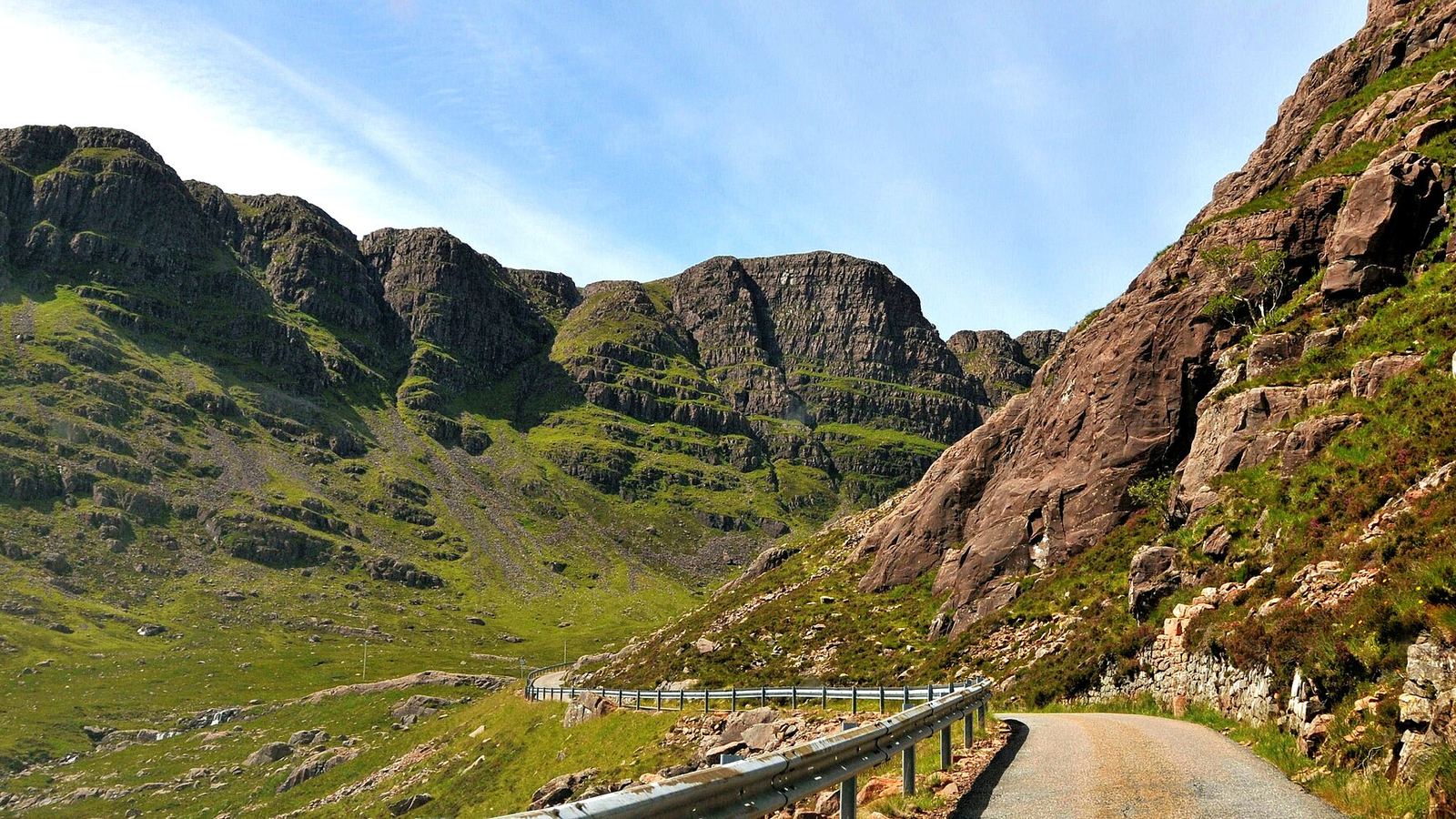
Rules for overlanding in the United Kingdom
Updated October 2026
🌐 Italiano · Français · Español
Is a guide mandatory in United Kingdom?
No, not needed for most trips
Our summary of the country advice published by the Italian Ministry of Foreign Affairs (Viaggiare Sicuri) on 9 August 2026.
Which driving licence do I need in the United Kingdom?
All vehicles
An Italian licence is accepted. Check what applies to the licence you hold.
An International Driving Permit states the categories it covers: check yours covers what you will actually drive. A car licence does not cover a motorcycle, and a heavy camper or a truck can need a higher category.
At the wheel
What insurance do I need to drive in the United Kingdom?
The national insurance certificate of a visitor whose vehicle is registered in Italy is valid in the United Kingdom. Check what applies to the policy you hold.
Driving someone else's vehicle
Carry a letter of authority from the owner with the signature authenticated.
Left-hand traffic, lights
Traffic drives on the left and overtakes on the right, and you must have your headlights adapted for left-hand driving: not doing so risks a fine of up to 1,000 GBP. Sidelights must be on from dusk to dawn, and dipped headlights from half an hour after sunset until half an hour before sunrise on roads with no public lighting, where lamps are more than 185 m apart, or where they are not working. Use dipped headlights, or front and rear fog lights, when visibility drops below 100 m.
What is the drink-driving limit in the United Kingdom?
The blood alcohol limit is 0.05% in Scotland, falling to 0.022% when measured on an evidential breathalyser, and 0.08% in the rest of the country.
Are helmets and seatbelts compulsory in the United Kingdom?
Seatbelts are compulsory in the front for driver and passenger and in the rear where they are fitted, and the rule applies to foreign-registered vehicles too; a non-resident with a medical exemption has to obtain a British exemption certificate on arrival. Children under 3 need a restraint suited to their weight, a rear-facing seat requires the airbag to be switched off, and children from 3 to 12 or under 135 cm need appropriate restraints. Helmets are compulsory for motorcyclists and passengers, sidecars excepted, and a visitor may use a helmet approved in their own country if those national standards match the British ones.
Triangle and hazard lights
A warning triangle is optional here; if you use one, place it 45 m from the obstacle on the same side of the road, and never on a motorway. Hazard lights must be on after a breakdown or crash that obstructs traffic, and must not be used while driving except to warn others of an imminent obstacle. A first-aid kit is recommended but not compulsory.
London charges and ULEZ
Drivers, foreign ones included, must pay a charge to drive and park in central London from 07:00 to 18:00 on weekdays and from 12:00 to 18:00 on public holidays, Christmas and New Year excepted. The Low Emission Zone covers older diesel trucks, buses, coaches, large vans and minibuses, along with other special vehicles in the truck and van categories such as campers and horseboxes, and its emission standards apply to foreign plates as well: to avoid the daily charge, a compliant vehicle not registered in Britain has to be registered with Transport for London. The Ultra Low Emission Zone runs 24 hours a day, every day except Christmas, and a similar scheme is being introduced in Edinburgh.
Is it safe to drive at night in the United Kingdom?
Most motorways are free and links with the continent are good, but the ministry asks for maximum care in the rougher parts of the country and on the smaller islands, where carriageways are narrow and surfaces can be poor, and advises against driving at night away from the main network. In summer, road accidents involving Italian holidaymakers are more frequent in rural Scotland and on the islands, with legal consequences if third parties are harmed, so drive defensively given the road layout, the surfaces and the strong winds and rain, and avoid moving at dusk or after dark.
What catches travellers out
ETA before departure
Italians need no visa for tourist stays of up to 6 months, but since 2 April 2025 an Electronic Travel Authorisation is a travel requirement. It is not technically a visa but an electronic authorisation for visa-exempt travellers on short stays, and you must hold it before you leave. Foreign nationals resident in the UK with a valid permit, including pre-settled and settled status, are exempt.
Passport only
Entry to the United Kingdom, airside transit included, is allowed only with a passport valid for the whole stay, and collective passports are not accepted; EU citizens turning up without a passport can be refused at the border. Only people in the EU Settlement Scheme, frontier workers, and EU citizens with family-reunification or medical-treatment permits can still travel on an identity card.
No cheese or salami
Since 12 April 2025, travellers from all EU countries may not bring products such as sandwiches, cheese, cured meats, raw meat or milk into Great Britain, whether packaged or bought duty-free, as a foot-and-mouth precaution. Anything found has to be handed over at the border or it is seized and destroyed immediately, and in the most serious cases fines in England reach 5,000 pounds. The ban does not apply to travellers arriving in Northern Ireland, Jersey, Guernsey or the Isle of Man.
Drugs
Drug legislation is severe: it is an offence not only to deal any drug, but also to take one, to hold it for personal use, to pass it to someone else even for free, or to let others take it in your home, and current penalties are particularly high. If you take prescribed medicines that count as controlled substances, morphine for example, carry a doctor's certificate translated into English and authenticated by a British consulate in Italy.
Vehicle, drones and permits
What do I need to bring my own vehicle into the United Kingdom?
GOV.UK states that you can usually use a vehicle with foreign number plates in the UK without registering or taxing it if you are visiting and do not plan to live there, the vehicle is registered and taxed in its home country, and you use it for up to 6 months in total (a single visit, or several shorter visits over 12 months). For England, Scotland and Wales it adds that no VAT or customs duty is paid on a temporarily imported vehicle if it is for your own private use, you are not a UK resident, you do not sell, lend or hire it in the UK and you re-export it within 6 months (or longer if you are eligible to use foreign number plates for longer); relief is claimed with form C110 and the 'nothing to declare' channel. The page gives separate rules for Northern Ireland. (GOV.UK — Importing vehicles into the UK: Temporary imports)
Vehicle insurance
UK law (Road Traffic Act 1988, section 143) provides that, subject to the other provisions of that Part of the Act, a person must not use a motor vehicle on a road or other public place unless a policy of insurance complying with the requirements of that Part is in force in relation to that use, and that acting in breach of this is an offence. The section applies in England, Wales and Scotland. It states the general rule and does not mention foreign-registered vehicles. (legislation.gov.uk — Road Traffic Act 1988, section 143 (Users of motor vehicles to be insured))
Can I bring and fly a drone in the United Kingdom?
The UK Civil Aviation Authority's Drone and Model Aircraft Code states that a Flyer ID is required to fly a drone or model aircraft weighing 100 g or more, and that an Operator ID is required for one that weighs 250 g or more, or 100 g or more with a camera. It states that neither ID is needed to fly one that weighs less than 100 g. The page does not address visitors from abroad. (UK Civil Aviation Authority — Drone and Model Aircraft Code: Getting what you need to fly legally)
Is wild camping allowed in the United Kingdom?
For Scotland, the Scottish Outdoor Access Code site states that you can enjoy the outdoors on most land if you act responsibly, which includes lightweight camping in a tent, in small numbers and for no more than two or three nights in one place. It adds that access rights do not include motor vehicles and that seasonal byelaws restrict camping in some areas, such as parts of Loch Lomond & The Trossachs National Park, where camping is only permitted within campsites or with a camping permit. The page covers Scotland only. (Scottish Outdoor Access Code (NatureScot) — Camping)
Can I drive off-road and in national parks in the United Kingdom?
In England and Wales, the Road Traffic Act 1988 (section 34) makes it an offence, subject to the exceptions in the section, to drive a mechanically propelled vehicle without lawful authority on to common land, moorland or any other land that is not part of a road, or on a road that is a footpath, bridleway or restricted byway. (legislation.gov.uk — Road Traffic Act 1988, section 34 (Prohibition of driving mechanically propelled vehicles elsewhere than on roads))
Can I bring a satellite phone or Starlink to the United Kingdom?
CEPT/ECC Decision (12)01 provides for the exemption from individual licensing and the free circulation and use of satellite mobile terminals operating under the control of networks in the range 1 to 3 GHz. The ECO Documentation Database records the United Kingdom as having implemented the Decision, so this is the CEPT decision as implemented by the United Kingdom. (CEPT ECO Documentation Database — ECC/DEC/(12)01, implementation status by country)
Going with your own vehicle?
6 local guides on GuideMeet work in the United Kingdom: they know the roads, the permits and the areas to avoid. You contact them directly, free and with no commission.
 Moto Travel Dude
London, UK Adam Bertenshaw
Ross-on-Wye, UK Mathias Asiimwe
Kampala, Uganda
Before you rely on this
This is our summary of advice written by the Italian Ministry of Foreign Affairs for Italian travellers, published on 9 August 2026. We summarise in good faith, but we cannot guarantee it is accurate, current or complete, and we take no responsibility for decisions made on the basis of it. Rules change without notice and are applied by officials at the border, not by websites. Always read the original source and the travel advice your own government publishes for United Kingdom before you travel. Where a guide's profile shows “Licence verified”, we found that licence in the official public register; otherwise GuideMeet has no way of checking whether an individual guide meets any standard mentioned here — ask them directly.
The points in "Vehicle, drones and permits" come from official sources of the country itself, cited next to each one.
Source: Viaggiare Sicuri — Italian Ministry of Foreign Affairs, updated 9 August 2026. Last checked by GuideMeet on 7 October 2026.