GuideMeet country page
Mongolia – overland guides and trips
Mongolia is pure off-road scale: open steppe, remote camps, and routes where local expertise matters. GuideMeet helps you find guides and travel companions for serious overland journeys.
Local overland guides and active trips in Mongolia on GuideMeet.
As of October 2026: 3 local guides on GuideMeet operating in Mongolia — 1 4x4, 1 motorcycle.
Local overland guides in Mongolia
 Samar Magic Tours Mongolia — Ulán Bator, Mongolia
Somos la Primera y Única Agencia de Viajes Receptiva en Mongolia, especializada en turismo de habla castellana (española) y también con guías locales en el idi...
- Arpan Dasgupta — Gurugram, India
My name is Arpan Dasgupta, popularly known as ADG, an avid motorcycle rider and 4×4 SUVs driving enthusiast. After 22 years in the corporate world, I embraced...
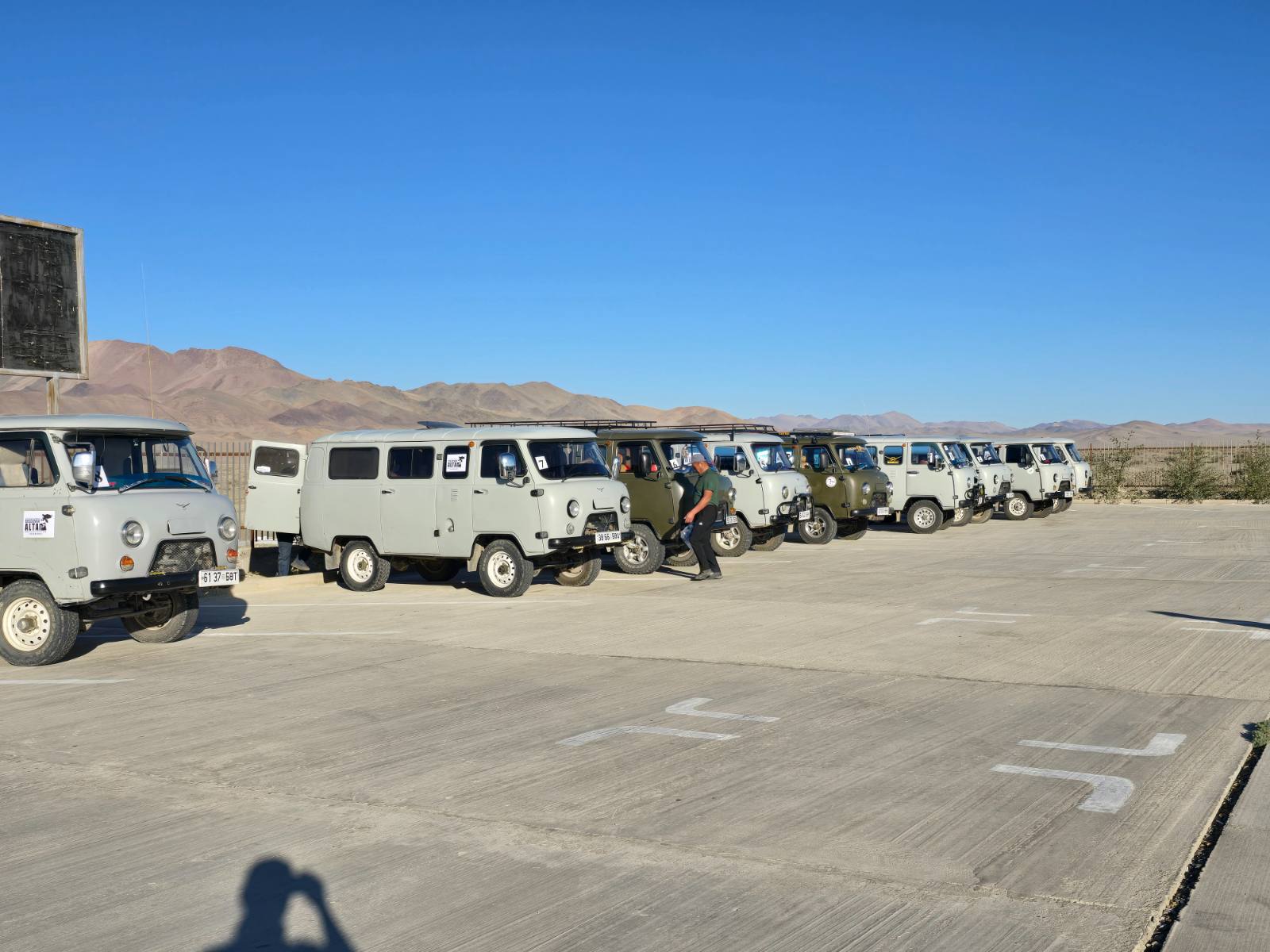 Daurenbek Sakhuan — Ölgii, Mongolia · 4x4 car, adventure motorcycle
Here is a polished version of your introduction: Hi everyone! My name is Dauren, and I am a local travel expert with over 13 years of experience. I live in Bay...
Active trips in Mongolia
- Motorcycle Expedition in Mongolia · 13 days
- Viaje a Mongolia en Privado con Samar Magic Tours · 7 days
Planning a trip in Mongolia?
Browse local guides for Mongolia and connect with experts who know the terrain, routes and border crossings. Or create your own trip and find travel companions.
Are you a local guide in Mongolia?
Join GuideMeet and get discovered by overland travelers looking for local knowledge, 4x4 support and expedition expertise in Mongolia.
Mongolia for overland travelers
Mongolia is the benchmark. When experienced overland travelers speak about the ultimate off-road destination — the place that defines the category, that separates the well-prepared from the optimistic — Mongolia is the answer that keeps coming up. At 1.5 million square kilometers, it is one of the largest landlocked countries on Earth, and the density of infrastructure across that space is essentially zero outside the capital. Almost no paved roads. No reliable fuel network beyond the main corridor. Vast distances between any two points with anything resembling a settlement. Extreme temperature swings — from minus forty in winter to plus forty in summer. And a landscape of such scale and emptiness that conventional navigation tools become inadequate and local knowledge becomes, quite literally, survival-critical.
This is the destination for serious overland travel. Not serious in the sense of difficult terrain for its own sake, but serious in the sense of commitment: you cannot approach Mongolia casually, and the country does not forgive lack of preparation.
The geography divides into four major environments, each with its own character and demand profile.
The Gobi Desert, occupying the southern third of the country, is the most internationally recognizable landscape and also the most misunderstood. The Gobi is not primarily a dune desert. It is overwhelmingly a gravel desert — vast plains of hard-packed gravel and stone, broken by rocky outcrops, dry riverbeds, and occasional sand sections where the wind has created genuine erg formations. The Khongoryn Els sand dunes in the South Gobi are spectacular and worth seeking out, but they represent perhaps five percent of the total Gobi experience. The rest is about navigating across surfaces that look simple but are not: the gravel flats are traversable at speed, but the dry riverbeds (dzuds) require reading the terrain carefully, and the sand sections demand the same tire management and momentum awareness as any Saharan equivalent. The temperature range in the Gobi is extreme: summer days above 40°C are common, nights can drop to near zero in late summer, and spring and autumn bring dust storms of remarkable intensity. Water sources are scarce and must be planned for. The Gobi is not forgiving of improvisation.
The Altai Mountains in the western part of the country represent the technical extreme of Mongolian overland travel. The Mongolian Altai range runs for nearly 1,000 kilometers along the borders with Russia and China, with peaks exceeding 4,000 meters. The passes here — many unnamed on standard maps, known primarily to local herders and the occasional expedition driver — are among the most demanding in Central Asia. River crossings are frequent and unpredictable: glacial meltwater levels change dramatically between morning and afternoon, and what is a knee-deep ford at 8am can be impassable by 2pm. The western Altai is genuine expedition territory: fuel must be carried for ranges exceeding 500 kilometers between resupply points, satellite communication is essential, and the terrain demands both high-clearance 4x4 capability and drivers who can manage river crossings, boulder fields, and high-altitude mud without external assistance. The cultural dimension here is also extraordinary: the Kazakh population of the western Altai practices eagle hunting, a tradition that has survived largely unchanged for centuries, and the ger camps of these communities offer a form of encounter with nomadic culture that has no equivalent in more accessible parts of Mongolia.
Khövsgöl Lake, in the far north near the Russian border, is a different world: a deep freshwater lake — the second largest by volume in Asia — surrounded by Siberian taiga, boreal forest, and high mountains. The northern approaches follow the Selenge River valley through forested terrain that feels closer to Siberia than to the steppe, and the tracks around the lake are seasonal and demanding, particularly in spring when the permafrost layer creates unpredictable soft patches. The region is inhabited by the Tsaatan reindeer herders, one of the world's most isolated indigenous groups, accessible only by horse or on foot from the nearest track head. Khövsgöl is for travelers who want wilderness over spectacle — vast, forested, cold, and deeply quiet.
The central steppe is what most people imagine when they think of Mongolia: endless rolling grasslands under enormous skies, with nothing visible in any direction except grass, sky, and the occasional white dot of a ger. This is the heartland of Mongolian nomadic culture, and the experience of driving across it — navigating by GPS coordinates rather than roads, stopping at ger camps for fermented mare's milk (airag) and dried curd, watching the landscape shift through the light of a long summer evening — is one of the most distinctive in the overland world. The central steppe is technically the least demanding of Mongolia's regions: surfaces are generally good, gradients are mild, and the main challenge is navigation and fuel management over long, unmarked distances. But it is also where the cultural immersion is deepest and where the particular rhythm of Mongolian travel — slow, horizontal, social — reveals itself most fully.
The Naadam festival, held annually in July across the country (with the main celebration in Ulaanbaatar), offers a remarkable itinerary anchor for overland travelers. The festival — featuring traditional wrestling, horse racing, and archery — draws Mongolian families from across the steppe, creating a natural convergence of nomadic culture that is accessible, visually extraordinary, and structurally unlike any equivalent event in the world. Building an overland route around the Naadam circuit — following the regional competitions in the weeks before the main event — gives a journey both temporal structure and cultural depth that pure terrain-focused travel cannot provide.
Vehicle requirements for Mongolia are non-negotiable. A standard 4x4 with adequate fuel range, high clearance, and off-road tires is the minimum. For western and northern routes, expedition-grade preparation is required: dual spare tires, comprehensive recovery equipment (winch, sand ladders, high-lift jack, tow straps), extended fuel range of at least 500 kilometers, water storage for multiple days, and a basic mechanical toolkit. The Land Cruiser 78 and 79 series are the dominant platforms among Mongolian guides and experienced overland travelers for good reason: they are mechanically simple, parts are available in Ulaanbaatar, and they have been proven on Mongolian terrain for decades. Russian UAZ vehicles are widely used by local operators and worth understanding — they will be the vehicles you encounter most frequently and whose owners are most likely to stop and assist. Satellite communication (Garmin inReach or equivalent) is not optional for remote routes; in the Altai and northern regions, it is the only reliable means of emergency communication.
The June-to-September travel window is not a suggestion but a constraint. Outside these months, the steppe is either locked under deep snow or softened by spring melt into conditions that trap vehicles and make navigation impossible. Even within the window, late June can bring heavy rain that turns river crossings dangerous, and late August sees the first cold fronts arriving in the north. The peak of July to mid-August offers the most reliable conditions, though also the most competition for ger camp hospitality.
The role of local guides in Mongolia cannot be overstated. In most overland destinations, a local guide adds depth and cultural access to a journey that is fundamentally navigable by a competent independent traveler. In Mongolia, local guides perform a different function: they are navigational systems in a country where the concept of a road is often theoretical, emergency responders in a context where mechanical breakdown can have genuinely serious consequences, and cultural translators in a society where the unwritten rules of nomadic hospitality — how to enter a ger, how to accept food, how to reciprocate — are not trivial courtesies but real social obligations. The best Mongolian guides know which river crossings are passable at which times of year, which families will allow camping near their ger, and how to read weather changes on the steppe before they arrive. This knowledge is not in any database.
GuideMeet connects serious overland travelers with exactly these guides. The platform makes it possible to find and contact local experts who know specific regions of Mongolia in depth — guides who have driven the Altai passes, who know the Gobi water sources, who can organize fuel caches for extended western routes, or who offer to join a journey as companions rather than employees. For a destination where local knowledge is the difference between an expedition and an emergency, having access to the right person before you leave Ulaanbaatar is not a convenience — it is the foundation of the whole journey.
Before you go: learn to drive on sand
New to dunes and desert pistes? Read our practical handbook: Sand driving in a 4x4 — the complete guide (tire pressures, dunes, getting unstuck, recovery, vehicle prep).
Travelling with a local guide
Not sure whether you need a guide, or how to pick one you have never met? Travelling with a local guide covers when a guide is genuinely needed, what to check before leaving (permits, vehicle, emergency contacts) and how to agree price and exceptions.
Travelling solo? You may only need a guide for one stretch
Handling most of the route yourself but not sure about this one? When a solo overlander needs a local guide for one stretch covers where this comes up, what the guide actually does, and how to arrange it.
Frequently asked questions
How do I find overland guides in Mongolia on GuideMeet?
Browse local guides for Mongolia on GuideMeet, compare their experience, vehicles and languages, and message them directly to plan routes, permits and border crossings. As of October 2026, there are 3 local guides on GuideMeet operating in Mongolia (1 4x4, 1 motorcycle).
How much does it cost to contact a guide in Mongolia?
Nothing — GuideMeet is free and takes no commission. You contact the guide directly on the platform and agree terms between yourselves, with no middleman.
Are you a local guide in Mongolia?
Join GuideMeet and get discovered by overland travelers looking for local knowledge, 4x4 support and expedition expertise in Mongolia.